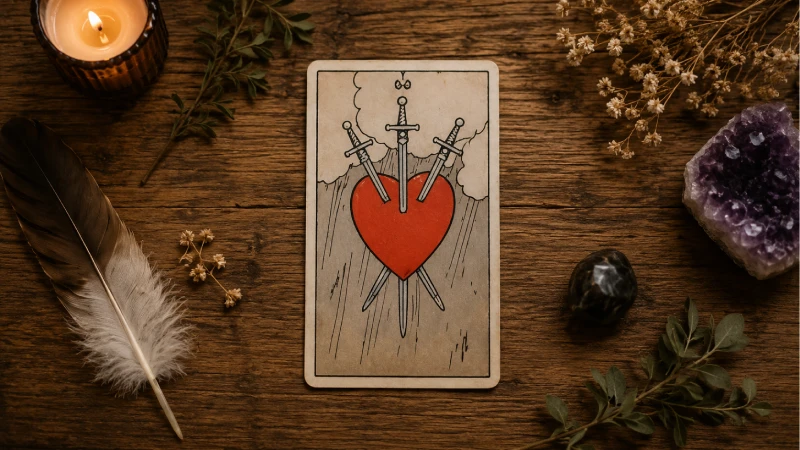
When Swords appear in a spread, the reading is dealing with thought, communication, or conflict. Swords describe what the mind is doing: the decisions being weighed, the truths being avoided or confronted, the anxiety sitting under the surface, or the tension that’s making everything harder.
In combinations, Swords ask: What truth, conflict, or decision is shaping events?
That question cuts through a lot of noise. Swords don’t describe what’s hoped for or what’s in motion; they describe what’s real, even when it’s uncomfortable. When they appear with other cards, they sharpen the reading: adding clarity, conflict, or mental weight to whatever is already there.
What Swords brings to a combination
Swords describe the mental and communicative layer of a situation. They show how something is being thought about, argued over, decided, or spoken, or not spoken.
In combinations, Swords cut through softness. A hopeful card beside a Swords card often reveals a harder edge: the worry behind the hope, the conflict beneath the plan, or the reality that still needs to be faced. This isn’t always negative. Swords also bring clarity: when a situation has been murky or avoidant, a Swords card names what’s actually happening.
They describe both external conflict and internal pressure. An argument between two people is Swords territory, but so is the internal back-and-forth of someone who can’t make a decision, or the anxiety running underneath an apparently functional situation.
Swords also mark boundaries and difficult honesty. When they appear alongside relationship cards, they point to a conversation that needs to happen or a truth that’s being held back.
When several Swords appear in one spread, the mental or communicative dimension of the situation is consuming everything else. The thinking, the arguing, or the anxiety has taken over.
Quick guide to Swords cards in combinations
| Card | In combinations, this card can add… |
|---|---|
| Ace of Swords | A moment of breakthrough clarity, or a hard truth cutting through confusion |
| Two of Swords | Avoidance, a stalled decision, or the tension of not wanting to see what’s in front of you |
| Three of Swords | Heartbreak, betrayal, or pain with a clear identifiable cause |
| Four of Swords | Rest after strain, or a deliberate withdrawal from conflict and mental pressure |
| Five of Swords | Win-lose dynamics, or the hollow feeling that follows a victory that cost more than expected |
| Six of Swords | A transition away from difficulty; things aren’t resolved, but the worst is being left behind |
| Seven of Swords | Deception, avoidance, or someone not being entirely honest about what they’re doing |
| Eight of Swords | Feeling trapped by one’s own thinking; restriction that’s partly self-imposed |
| Nine of Swords | Anxiety or dread running well ahead of what’s actually happening |
| Ten of Swords | A definitive ending, usually after a hard period; things have reached their lowest point, and the situation cannot continue in the same form |
| Page of Swords | Sharp curiosity, watchfulness, or communication that’s quick but not always tactful |
| Knight of Swords | Fast, decisive movement or speech that doesn’t slow down to consider the consequences |
| Queen of Swords | Clear perception, directness, and the ability to cut through pretence without cruelty |
| King of Swords | Authoritative thinking and the capacity to make hard calls without being swayed |
Swords with Major Arcana cards
Major Arcana cards describe broad forces and themes. Swords bring those themes down to the level of thought, communication, and conflict: how the situation is being processed mentally, and what decisions or truths it demands.
The Lovers + Seven of Swords
The Lovers describes a choice, a union, or a moment of alignment. With the Seven of Swords, something in that picture isn’t transparent. One person may not be fully honest, or the choice being made is one that someone is concealing from themselves or others. This combination raises the question of what isn’t being said.
The Moon + Two of Swords
The Moon points to uncertainty, illusion, and things that aren’t fully visible. The Two of Swords compounds that: the blindfold is chosen. Someone is deliberately not looking at something they’d rather not see. This combination describes avoidance layered on top of confusion, which makes the situation harder to read clearly.
Justice + Ace of Swords
Justice describes fairness, consequence, and honest accounting. The Ace of Swords beside it sharpens the whole picture: this is a moment for clear thinking with no room for wishful reasoning. The combination points to a decision or judgement that needs to be made with precision.
Swords with the other suits
Swords + Swords
When several Swords appear together, thought and conflict are running the situation. Look at which cards: several in the middle range (Five, Seven, Eight, Nine) suggest a situation where anxiety, argument, or avoidance has built up over time. Several higher Swords can describe a crisis point that’s about to resolve, or already has.
Example: Eight of Swords + Nine of Swords. Restriction and anxiety feeding each other. The Eight describes a feeling of being trapped; the Nine adds the grinding, sleepless worry that follows. Together they describe a mental state, not just a circumstance.
Swords + Wands
Both suits are active, but they work differently. Wands act from instinct and desire; Swords act from decision and analysis. Together they describe someone thinking and moving simultaneously, or a situation where the impulse to act is running up against what the mind actually knows. The combination can be sharp and decisive, or it can point to action that should have slowed down.
Example: Five of Swords + Knight of Wands. Fast movement combined with conflict that leaves a cost behind it. The Knight moves quickly; the Five of Swords suggests what that speed damages along the way.
Swords + Cups
Swords and Cups are one of the more common difficult pairings, because they represent the tension between thinking and feeling. Swords describe what’s known or concluded; Cups describe what’s felt. When the two don’t agree, the combination reveals that split directly.
Example: Ace of Swords + Five of Cups. Clarity about a loss. The Ace cuts through: the situation is understood, and why. The Five holds the grief. This combination isn’t about confusion; it’s about understanding something painful with complete clarity.
Swords + Pentacles
Swords bring mental pressure; Pentacles bring material reality. Together they describe the stress of practical life: financial worry, difficult decisions about work or resources, or the mental load of keeping everything functioning. When the Swords card is a difficult one, the combination points to anxiety about a real and specific practical problem.
Example: Nine of Swords + Four of Pentacles. Anxiety about financial security. The Nine brings the grinding worry; the Four describes holding on tightly, perhaps too tightly, to what’s been accumulated. The combination suggests fear is driving the grip.
Reading multiple Swords cards together
When Swords dominate a spread, thought, conflict, or communication is the central experience of the situation.
Several low-numbered Swords (Ace to Four): Thinking that’s beginning, a decision forming, or a conflict in its early stages. The Ace and Two together describe someone standing at a threshold: a truth is arriving but hasn’t fully landed yet.
Several high-numbered Swords (Seven to Ten): The situation has been building for a while, and the pressure is high. These cards together point to a crisis point, or to the long mental aftermath of something difficult. The Ten in this cluster is sometimes a relief: things have hit their lowest point and the only direction is forward.
Multiple Swords court cards: Several strong-minded people are in play, each with their own perspective and agenda. Or the different courts describe competing internal voices: the Page’s sharp questioning, the Queen’s cool perception, the King’s need to decide.
Swords dominating a spread about relationships or emotions: The emotional situation is being processed intellectually rather than felt. Thinking has taken over from feeling. This isn’t wrong, but it may point to what’s being avoided.
Swords in advice positions: The spread is pointing toward honesty, a conversation, a decision, or a clearer way of seeing the situation. The specific card matters: the Ace suggests cutting through to the truth, while the Two suggests that avoiding a decision is no longer working.
Swords in outcome positions: The resolution involves a decision, a confrontation, or a truth finally being named. Whatever the spread has described, the ending is mental rather than material or emotional: something understood, concluded, or spoken.
How Swords behave beside other cards
Swords beside a hopeful or positive card: Swords introduce the complication. A warm or optimistic card sits differently when a Swords card is next to it. The hope is real, but so is the difficulty. The combination describes what has to be faced in order for the positive outcome to hold.
Swords beside cards of healing or rest: A Swords card beside something like the Star or the Four of Cups names what the healing is recovering from. The Swords card identifies the difficulty; the other card describes what’s available to meet it.
Swords beside a Major Arcana card: Swords make large themes specific. Justice becomes about a decision that needs an honest answer. The World becomes about what has been understood, concluded, or finally spoken before the next phase begins. Swords bring the big picture down to the level of thought and action.
Swords with court cards from other suits: A Swords court alongside a Cups or Wands court describes a dynamic tension: someone direct and analytical alongside someone emotional or impulsive. Look at whether they’re working together or cutting across each other.
Swords in a position of what’s hidden: When a Swords card appears in a position describing what’s not visible or not fully acknowledged, it points to an unacknowledged truth, a suppressed fear, or a thought pattern running underneath a more conscious narrative.
How to use this page
The table is a starting point for live readings. When a Swords card appears, use it to identify what kind of mental or communicative dimension it’s adding, then bring in the spread position and the surrounding cards.
The central question for Swords is: What truth, conflict, or decision is shaping events?
That question applies to every Swords card in the spread, not just the most prominent one. A single Swords card in an otherwise calm reading can change the entire tone.
Explore more tarot combinations: