How to Read Tarot Combinations
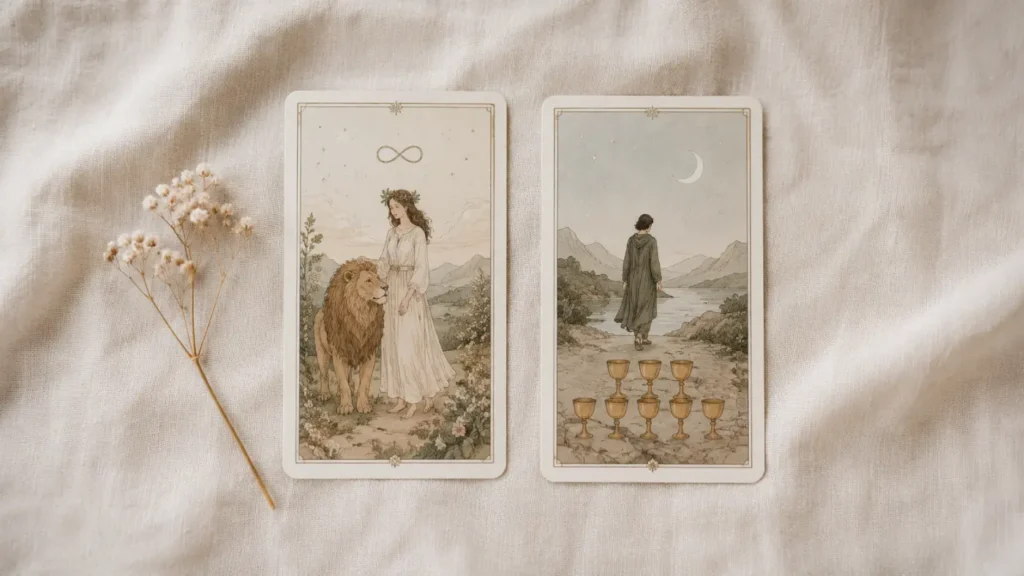
You pull two tarot cards. You know what each one means on its own. The first card makes sense. The second card makes sense. Together, they’re harder to read.
Do you blend the meanings? Pick whichever card feels stronger? Read them in order? Go looking for the exact pairing in a book somewhere?
This is usually the point where readers stop trusting what they already know, even though they know more than they think. You don’t need to memorise every possible pair of cards. You need a way of reading what happens between them.
The simple rule
Don’t add the two meanings together. Look at what changes when the cards sit side by side.
A card might show the surface of a situation while the one next to it shows what’s underneath it. Or one shows the hope and the other shows the fear sitting just behind it. Sometimes one card is pushing forward and the other is holding everything back.
That relationship is the combination. Once you see it, the cards stop acting like two separate answers and start showing you the actual shape of the situation.
The five questions to ask
When two cards land together and the meaning isn’t obvious, work through these.
1. Which card is leading?
In most combinations, one card is carrying the main message and the other is shading it.
Major Arcana cards tend to lead, since they point to bigger themes: change, choice, awakening, restriction, healing, completion. If The Hanged Man turns up beside the Eight of Pentacles, The Hanged Man is probably setting the theme, pause, waiting, a shift in perspective, and the Eight of Pentacles shows where that’s actually playing out: work, study, a skill you’re building, daily effort.
If there’s no Major Arcana card in the pair, look for whichever card feels strongest against the question that was asked. That might be the one with the clearest image, the strongest emotional pull, or the most obvious link to what’s going on.
2. What do the cards have in common?
Look for whatever repeats. Are both cards circling movement? Waiting? Pressure? Choice? Loss? Protection? Desire? Avoidance?
Shared suits are a useful shortcut. Cups tend to pull the reading into emotion, relationships, intuition, longing. Swords usually mean thoughts, decisions, conflict, communication. Wands bring energy, action, creativity, restlessness. Pentacles ground things in work, money, the body, home, the practical end of life.
Don’t stop at the suit, though. Check the images too. Water turning up twice, roads, mountains, closed doors, hands, animals, figures with their backs turned or facing each other: repetition like this in a spread is rarely just coincidence.
3. Where do the cards disagree?
Cards don’t always point the same way, and that’s not a fault in the reading. It’s often the most useful part of it.
The Knight of Wands next to the Four of Cups won’t blend neatly, and it shouldn’t. One wants movement, action, momentum. The other is withdrawn, flat, checked out emotionally. Put together, they can describe someone who wants change but isn’t able to fully show up for it yet.
When two cards clash like this, ask yourself: what does it mean if both of these are true at once? That question is what keeps both cards in the room, rather than letting you pick the one you like and quietly drop the other.
4. Is the energy moving or stuck?
Look at what happens as you go from one card to the next. Does the reading move from confusion towards clarity? From pressure towards release? From hope into hesitation? From stillness into action?
The Ten of Wands followed by the Six of Swords, for instance, can show someone who’s been carrying a heavy load but has started to move away from whatever created it.
Order matters more in spreads with set positions, past, present, future, challenge, advice, outcome. A hard card followed by something calmer reads very differently to a calm card followed by tension.
5. Can you say it in one plain sentence?
This is the best check you have. Once you’ve worked through the cards together, try summing the combination up in one sentence, no tarot jargon allowed.
Seven of Cups + Two of Pentacles: “There are too many options on the table, and the practical side of things is getting neglected.”
The Tower + The Star: “Something’s been disrupted, but there’s recovery and clarity waiting on the other side of it.”
The Lovers + The Devil: “There’s a choice here, but attachment, desire, or an old pattern might be making it harder to choose freely.”
If you can put the combination into a plain sentence, you understand it well enough to use it. If the sentence still feels vague, go back through the five questions.
Quick examples
The Tower + The Star
The Tower brings disruption, shock, the collapse of something that wasn’t stable to begin with. The Star brings healing, calm, perspective, renewal. Together, these don’t soften The Tower, and they don’t undo the disruption. What they do is shift the direction of the message.
The reading is likely saying that something difficult has broken open, and what follows isn’t only the damage. There’s also room to recover, see things clearly, and rebuild from somewhere more honest.
Plain sentence: “Something’s been shaken up, but healing and clarity are possible once the dust settles.”
The Fool + Four of Pentacles
The Fool wants movement, freedom, a step into the unknown. The Four of Pentacles wants safety, control, something solid underfoot. Together, they usually point to the tension between risk and security.
Someone might want to start again but be held back by the fear of losing what they’ve got. Or the reading could be asking whether playing it safe has quietly turned into its own kind of limitation.
Plain sentence: “There’s a pull towards freedom, but fear of losing security is keeping things exactly where they are.”
The Lovers + The Devil
The Lovers usually points to choice, alignment, attraction, a meaningful bond. The Devil brings attachment, temptation, dependency, fear, the patterns that are hard to break. Together, they can describe a choice that isn’t as free as it looks on the surface. Desire might be part of it. So might habit, fear, power, or emotional entanglement.
This combination doesn’t automatically mean something’s wrong. But it is asking for some honesty about what’s actually shaping the choice.
Plain sentence: “There’s a strong pull here, but it might be shaped by attachment or an old pattern rather than free choice.”
When a combination doesn’t make sense
Not every pair of cards clicks straight away.
Start by reading the rest of the spread. Often the cards around a stuck pair explain what it’s trying to say. Try the cards in reverse order too; sometimes the meaning opens up once you read from the second card back to the first.
And don’t force every pair to carry equal weight. Some cards in a spread are closely linked. Others are just sitting near each other. Treating every possible pairing as a major message tends to make the reading crowded and harder to trust, not clearer.
A reading doesn’t need to explain everything. It just needs to follow what actually feels relevant.
A simple practice
Pull two cards and read them as a pair. Ask:
- Which card is leading?
- What do they share?
- Where do they disagree?
- Is the energy moving or stuck?
- What’s the message in one plain sentence?
Use it as a daily habit if that’s useful, or just pull it out whenever a pairing in a real reading throws you.
Explore Tarot Combinations
Choose the guide that best matches your reading. Start with the method if you’re learning how combinations work, or browse by card type if you already know what you’re looking for.
How to Read Tarot Combinations
A practical guide to reading two or more cards together without memorising every possible pair.

22 Cards
Major Arcana Combinations
How the Major Arcana cards combine with the rest of the deck, from turning points to deeper patterns.
Combinations by suit
Fire
Wands Tarot Combinations
Action, desire, momentum, creativity, conflict, pressure and burnout.

Water
Cups Tarot Combinations
Emotion, relationships, longing, healing, intuition, attachment and the inner world.
Air
Swords Tarot Combinations
Thought, conflict, communication, anxiety, decisions, truth, clarity and mental patterns.

Earth
Pentacles Tarot Combinations
Work, money, home, stability, effort, resources and practical reality.
How to use these guides
Choose the Major Arcana card that appears in your reading, then look for the card it appears with.
The meanings aren’t fixed rules. The same combination can change depending on the question, the spread position, and the surrounding cards. Use these guides to compare possible meanings, build confidence, and get a clearer sense of how the cards are working together.