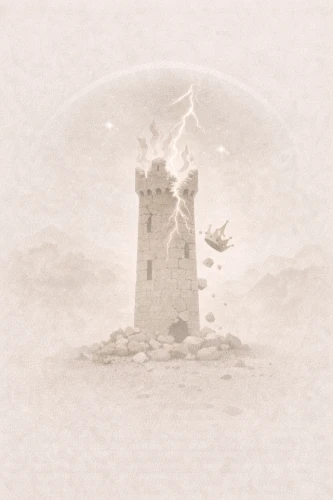
The Tower is card sixteen of the Major Arcana. It deals with events that overturn the existing situation fast, faster than anyone involved has time to properly prepare for. The change can arrive from outside, something nobody in the situation caused or could have prevented, or it can be the visible result of pressure that had been quietly building for a long time before it finally gave way. Sometimes what collapses really was unstable. Sometimes something that was working perfectly well gets damaged by an event nobody saw coming and nobody deserved.
What sits beside The Tower shows what’s actually been hit: a job, a relationship, a reputation, a financial position, a belief someone held, or a system that other people relied on. It also shows who has to respond, and what they’re actually dealing with in practical terms once the dust starts to settle.
How The Tower Changes in Tarot Combinations
Beside ending and transformation cards, like Death or Judgement, this isn’t just “the change is sudden and final.” It can mean a breakup or a job loss with genuinely no route back to how things were. It can mean a role ending publicly, in front of other people, rather than quietly. It can mean a decision that was always coming arrives much sooner than expected, or a system collapsing before anything exists to replace it. Sometimes it’s something that was already unstable finally giving way. Sometimes the change is final but still poorly understood, even by the person it happened to, and sometimes the ending is caused by a specific event rather than by anyone actually choosing it.
Beside hope and recovery cards, like The Star or Temperance, don’t assume this is automatically reassuring. It can describe practical support arriving after a crisis, which is genuinely useful. It can also describe hope showing up before the situation has actually stabilised, people trying to rebuild faster than is realistic, or denial wearing optimism as a disguise. Sometimes relief only arrives once the immediate danger has clearly passed, and even then, improvement here is often partial, uneven, and far from certain.
Beside cards that already describe difficulty, don’t assume the situation was necessarily under strain beforehand in every case. This combination can describe anxiety amplifying a shock that was, on its own, actually manageable. It can describe a controlling system finally being exposed to people outside it, confusion about what actually happened, or conflict escalating because nobody involved is willing to back down. Financial pressure can make the fallout considerably worse than it would otherwise be. Someone can end up blaming themselves for something that was genuinely outside their control. And sometimes a problem that had existed quietly for a long time only becomes visible because the crisis has stripped away whatever was covering it.
The Tower with Major Arcana Cards
The Emperor alongside The Tower often means leadership failure: removal from office, an institution collapsing, an authority figure losing control of a situation they thought they had handled, or a rigid plan failing under pressure it wasn’t built to withstand. The Hierophant can describe a scandal, a loss of faith in an institution, formal rules becoming genuinely unworkable, public exposure, or someone leaving a system abruptly and without much warning.
The Lovers next to The Tower usually means a relationship shocked by a disclosure, a sudden and unplanned choice, an outright breakup, or someone’s values shifting sharply in the wake of a specific event. Wheel of Fortune alongside it often points to circumstances changing faster than anyone can realistically manage, a sharp reversal, or a piece of luck, good or bad, with effects that last well beyond the moment it happened.
Justice beside The Tower frequently means an abrupt ruling, an official decision landing without much notice, a legal shock, new evidence changing a case entirely, or an unfair judgement finally being overturned. The Moon next to it points to panic, incomplete information, rumours spreading faster than facts, confusion, hidden facts surfacing in pieces, or genuinely not yet knowing how big the problem actually is. The World alongside The Tower can describe a major chapter cut short rather than completed, a public ending, or closure arriving before anyone involved actually feels ready for it. The Hanged Man beside it often means something that had been stuck getting forced into motion, or someone simply losing the ability to keep waiting any longer.
The Tower with Minor Arcana Cards
Wands combinations tend to involve project cancellation, a career reversal, public failure, leadership conflict, sudden burnout, a plan losing the support it needs to continue, a launch going badly wrong, ambition colliding with a reality it didn’t account for, conflict escalating faster than anyone expected, or a role and reputation changing overnight.
Cups combinations move into relationships and feeling: a breakup, a disclosure that changes everything, betrayal, a family crisis, sudden grief, emotional shock, a friendship group splitting apart, a confession that permanently alters a relationship, an idealised version of someone or something collapsing, or realising a connection was never quite what it seemed to be.
Swords combinations tend to involve damaging information, harsh words that can’t be walked back, an argument escalating past the point of control, legal news, a decision that arrives without any real warning, exposure, a plan falling apart the moment it’s actually scrutinised, panic, or a truth landing in a way that produces chaos rather than any real relief.
Pentacles combinations are the most material: redundancy, a sudden expense, job loss, property damage, lost income, a business failing, an investment dropping sharply, housing instability, a contract ending abruptly, a practical system breaking down, or financial strain turning urgent with very little warning. These situations aren’t automatically more recoverable than any other kind of Tower pairing. Practical damage is still damage.
Court Cards
Court cards next to The Tower can describe a messenger delivering genuinely bad news, a reckless person actively escalating a problem that could have stayed smaller, or a confident person losing control of a situation in full view of other people. It can be a manager whose decisions have failed and who now has to answer for it, or someone who was expected to stay calm finding themselves completely overwhelmed instead. It can point to a younger or less experienced person suddenly caught in the middle of an adult-sized crisis, a leader working hard to contain reputational damage, or someone whose usual approach simply stops working once real pressure is applied to it. It can also point to the person actually causing the disruption, rather than someone merely reacting to it.
Key The Tower Tarot Combinations
The Tower + The Star
This pairing isn’t automatically reassuring, and it’s worth resisting the pull to read it that way by default. It can describe real support or genuine hope showing up after a crisis, or the first sign that the worst of it may actually be over. It can also describe optimism arriving before anything has actually been rebuilt, people making plans while they’re still in shock, or someone idealising a better future specifically because the present moment is genuinely unbearable to sit inside.
Recovery here is possible, but it isn’t guaranteed by the presence of these two cards together, and the collapse didn’t have to happen in order for The Star to show up. Sometimes this pairing describes a public crisis followed, eventually, by renewed visibility or restored trust. Sometimes it just describes the beginning of a long and uncertain process with no assurance about how it turns out.
The Tower + Death
An ending with no time to prepare for it. This pairing can describe redundancy, eviction, a sudden breakup, removal from a role, or a closure that lands all at once rather than gradually. It can describe something collapsing in a way that genuinely can’t be restored to what it was. This is usually a clear before-and-after moment, and grief and practical fallout tend to arrive together rather than one after the other.
The finality involved often only becomes fully clear once the initial shock has worn off. This ending may be necessary. It may also be unfair, overdue, or simply devastating, and none of those readings cancel out the others. Which one applies depends entirely on the rest of the spread and the actual situation being read.
The Tower + The Devil
Several distinct things can be happening here, and it’s worth naming them individually rather than defaulting to one story. This pairing can describe an abusive or controlling system being exposed to people outside it. It can describe addiction or excess causing a visible, undeniable crisis, or financial and emotional dependency becoming impossible to keep hidden any longer. It can mean a sudden and involuntary withdrawal from something someone had come to depend on, or someone losing access to the very structure that had been containing a harmful habit.
Destructive behaviour can be reaching real consequences here, which isn’t the same as the compulsion behind it actually going away. Sometimes the crisis happens while the underlying pull is still fully present. And sometimes what’s really going on is that one form of control has collapsed only for another to move in and take its place. None of this makes the collapse automatically effective or useful. Sometimes it just happens, and the underlying problem is still there afterward.
The Tower + The Moon
Bad news arriving before anyone has the full facts. This pairing can describe panic spreading through rumour rather than through anything confirmed, someone badly misjudging how serious a situation actually is, or a sudden event whose causes aren’t yet clear to anyone involved. Secrets can be surfacing in fragments here rather than all at once, and fear tends to fill in whatever gaps the missing information leaves behind.
This combination often describes a relationship or family shock that nobody fully understands yet, including the people closest to it. It can also point to real uncertainty about whether the danger has actually passed or is still active. That uncertainty is often the point of the pairing, not a problem to be resolved by simply waiting for more information.
The Tower + Temperance
Emergency management. This pairing usually describes someone containing immediate damage rather than fixing the underlying cause of it: stabilising what’s broken, deciding what still needs to be patched and what needs to be replaced outright, or working to keep daily life running while something significant remains genuinely unstable underneath it.
This can be real, competent crisis management, and it can also be underreacting to something that actually needs a bigger response than it’s getting. Distributing responsibility after a crisis can be sensible and necessary. It can also be a way of avoiding the harder decision that the situation is actually asking for. This pairing sometimes describes harm reduction rather than any real resolution, and both possibilities, competent handling and dangerous minimising, are worth holding at once rather than picking one by default.
Quick The Tower Tarot Combination Meanings
| Combination | Meaning |
|---|---|
| The Tower + The Fool | A fresh start thrown into chaos before it’s found its footing. |
| The Tower + The Magician | A plan failing publicly, or someone’s claimed ability turning out weaker than it looked. |
| The Tower + The High Priestess | A secret surfacing fast enough to change the whole situation at once. |
| The Tower + The Empress | A family, home, pregnancy, caregiving role, or creative project hit by an unexpected event. |
| The Tower + The Emperor | A leader losing control, or a system failing under pressure it wasn’t built for. |
| The Tower + The Hierophant | A scandal or shock damaging trust in an institution or tradition. |
| The Tower + The Lovers | A disclosure, choice, or event changing a relationship immediately. |
| The Tower + The Chariot | A plan stopped by circumstances that determination alone can’t push through. |
| The Tower + Strength | A crisis testing whether someone can stay functional under real pressure. |
| The Tower + The Hermit | A private realisation or an outside event ending a long stretch of withdrawal. |
| The Tower + Wheel of Fortune | A sharp reversal in circumstances with very little time to adjust. |
| The Tower + Justice | An abrupt ruling, legal development, or piece of evidence changing the outcome. |
| The Tower + The Hanged Man | A stalled situation forced into motion before anyone feels ready for it. |
| The Tower + Death | An ending arriving with no real preparation time beforehand. |
| The Tower + Temperance | Containing immediate damage while working out what needs repair and what needs replacing. |
| The Tower + The Devil | A harmful pattern reaching a crisis that’s now visible to everyone. |
| The Tower + The Star | Hope or support appearing after the shock, before the damage is actually repaired. |
| The Tower + The Moon | Bad news or disruption arriving before anyone understands the full picture. |
| The Tower + The Sun | A public revelation that clears up confusion but creates immediate fallout of its own. |
| The Tower + Judgement | An event forcing a decision that can no longer be put off. |
| The Tower + The World | A major chapter ending abruptly rather than completing on its own terms. |
| The Tower + Ace of Wands | A new project starting in chaotic conditions, or an old one replaced overnight. |
| The Tower + Two of Wands | A plan scrapped before it’s even had the chance to properly begin. |
| The Tower + Three of Wands | An expansion derailed by something outside anyone’s forecasting. |
| The Tower + Four of Wands | A celebration or milestone disrupted right as it was meant to happen. |
| The Tower + Five of Wands | Competition or disagreement escalating into open conflict. |
| The Tower + Six of Wands | A public success, title, or reputation suddenly undermined. |
| The Tower + Seven of Wands | A defended position overwhelmed faster than it could be held. |
| The Tower + Eight of Wands | Fast-moving events accelerating into something no one can fully steer. |
| The Tower + Nine of Wands | The last of someone’s defences finally giving out. |
| The Tower + Ten of Wands | An overloaded situation finally failing because there’s no capacity left to absorb more. |
| The Tower + Page of Wands | An early idea derailed before it had time to develop. |
| The Tower + Knight of Wands | Fast, reckless movement colliding directly with something it couldn’t get past. |
| The Tower + Queen of Wands | A confident, capable person suddenly facing a situation they can’t fully control. |
| The Tower + King of Wands | Established authority or leadership hit by a challenge it didn’t see coming. |
| The Tower + Ace of Cups | A new emotional connection disrupted right after it opened. |
| The Tower + Two of Cups | A relationship changed immediately by an event, confession, or betrayal. |
| The Tower + Three of Cups | A friend group or celebration disrupted by something sudden. |
| The Tower + Four of Cups | Withdrawal broken open by an event nobody had time to brace for. |
| The Tower + Five of Cups | A loss that arrives too fast to fully process at first. |
| The Tower + Six of Cups | A connection to the past disrupted by something happening in the present. |
| The Tower + Seven of Cups | Reality collapsing several illusions at the same time. |
| The Tower + Eight of Cups | Leaving suddenly because staying has stopped being possible. |
| The Tower + Nine of Cups | A comfortable situation disrupted right as it seemed settled. |
| The Tower + Ten of Cups | A family or domestic situation losing stability everyone had assumed was solid. |
| The Tower + Page of Cups | An emotionally open moment interrupted before it could fully develop. |
| The Tower + Knight of Cups | A romantic pursuit derailed by something neither person planned for. |
| The Tower + Queen of Cups | Someone emotionally attuned suddenly overwhelmed by a shock. |
| The Tower + King of Cups | Emotional composure genuinely tested by an unexpected event. |
| The Tower + Ace of Swords | A fact or statement changing the situation in one stroke. |
| The Tower + Two of Swords | An avoided decision being made by circumstances instead. |
| The Tower + Three of Swords | A painful truth, breakup, or loss arriving without warning. |
| The Tower + Four of Swords | A period of rest interrupted before it could actually do its job. |
| The Tower + Five of Swords | A conflict escalating into something with real, lasting damage attached. |
| The Tower + Six of Swords | A departure forced by events rather than chosen calmly. |
| The Tower + Seven of Swords | A deception exposed before the person responsible can contain it. |
| The Tower + Eight of Swords | A trapped feeling forced open by an outside event rather than resolved from within. |
| The Tower + Nine of Swords | An event giving real substance to fears that had previously felt unconfirmed. |
| The Tower + Ten of Swords | A conclusion so sudden and complete that there’s nothing left to add. |
| The Tower + Page of Swords | News landing before anyone’s had a chance to prepare for it. |
| The Tower + Knight of Swords | An argument, accusation, or rash decision escalating too fast to take back. |
| The Tower + Queen of Swords | Clear thinking put to the test in the middle of real disruption. |
| The Tower + King of Swords | A ruling or judgement forced by circumstances rather than reached through deliberation. |
| The Tower + Ace of Pentacles | A new financial or practical arrangement beginning because the old one failed. |
| The Tower + Two of Pentacles | One extra pressure making an already stretched situation unmanageable. |
| The Tower + Three of Pentacles | A collaborative project or agreement collapsing without warning. |
| The Tower + Four of Pentacles | Money, housing, or security slipping out of someone’s control. |
| The Tower + Five of Pentacles | An unexpected financial loss, job problem, or drop in stability. |
| The Tower + Six of Pentacles | A financial arrangement upended, changing who’s actually giving and who’s receiving. |
| The Tower + Seven of Pentacles | A long-term investment or plan suddenly thrown into real uncertainty. |
| The Tower + Eight of Pentacles | Sustained, careful work disrupted by something outside anyone’s control. |
| The Tower + Nine of Pentacles | A position of independence suddenly less secure than it appeared. |
| The Tower + Ten of Pentacles | A family, property, inheritance, or financial structure hit by a major shock. |
| The Tower + Page of Pentacles | An early practical plan disrupted before it had a real chance to take shape. |
| The Tower + Knight of Pentacles | Steady, methodical progress interrupted by something sudden and outside anyone’s plan. |
| The Tower + Queen of Pentacles | Someone practical and grounded suddenly facing a genuinely destabilising event. |
| The Tower + King of Pentacles | A person with financial authority losing control of a material situation. |
Tips for Reading The Tower in Combinations
- Don’t default to predicting catastrophe. This card describes overturned situations, not automatic disaster, and the scale genuinely varies from reading to reading.
- Work out whether the event is future, ongoing, or already happened. That timing changes what the rest of the reading is actually asking.
- Identify what specifically changes in practical terms. A job, a relationship, a living situation, a reputation, a belief. Naming it precisely is more useful than a general sense of upheaval.
- Keep suddenness and severity as separate questions. Something can be very sudden and fairly minor, or building for a long time and genuinely severe. They don’t always travel together.
- Ask whether the event came from accumulated pressure or from somewhere outside the situation entirely. That distinction matters more than whether the outcome was good or bad.
- Don’t assume the collapse was deserved or necessary. Some of what The Tower describes is simply bad luck landing on something that was working fine.
- Check what the person actually has to work with: support, options, and any immediate practical needs that have to be addressed before anything else can happen.
- Court cards can show who caused the event, who’s delivering the news, or who’s most affected by it. These are three different roles, and it’s worth being clear on which one applies.
- If you read reversals, look for avoidance, a failure that’s been delayed rather than prevented, an internal crisis rather than an external one, damage that’s partial rather than total, or a disruption that never becomes as severe as it looked like it might.
Conclusion
The Tower shows where the existing situation is being overturned faster than the usual ways of coping can keep up with it. The questions worth asking are practical ones: what has actually changed, whether whatever caused this is still active or already over, and what needs immediate attention before anyone starts looking for a larger meaning in it. Those three questions matter more than any story about growth or necessity that the surrounding cards might seem to invite.