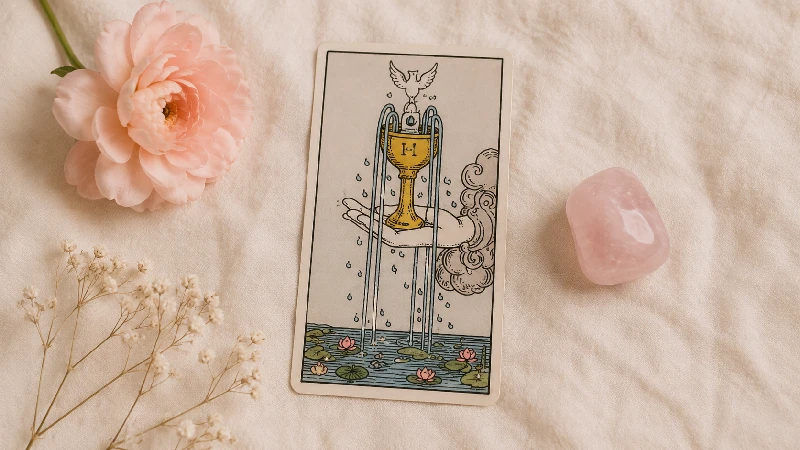
When you pull one or more Cups cards in a spread, the reading is touching on emotional life: what someone feels, what they want, what they fear losing, or how the heart is responding to what’s happening.
In combinations, Cups carry a central question: What is being felt, and how is that feeling shaping the situation?
That question can point in many directions. Cups describe love and longing, grief and healing, attachment and distance, the inner life and the imagination. When they appear with other cards, they add an emotional dimension that often explains why a situation is experienced the way it is, even when the surface events look straightforward.
What Cups brings to a combination
Cups describe the emotional and relational layer of a situation. Where Wands show what’s in motion, Cups show what’s being felt about it.
In combinations, Cups soften, deepen, or complicate the card they appear beside. A practical card like the Six of Pentacles takes on a different quality when paired with a Cups card: it’s no longer just about giving and receiving resources, it’s about what that exchange means emotionally.
Cups also slow things down. They add interiority, memory, and feeling to situations that might otherwise look purely active or external. When a spread is heavy with Cups, the reading is often about an internal process rather than an external one: something being worked through emotionally rather than acted on.
They describe relationships, and not just romantic ones. Family, friendship, loss, connection, and longing all belong to Cups. When they appear alongside cards about work, money, or action, they point to the emotional stakes of those situations.
Quick guide to Cups cards in combinations
| Card | In combinations, this card can add… |
|---|---|
| Ace of Cups | The opening of emotional possibility; a new feeling, connection, or relationship in its earliest form |
| Two of Cups | Mutual connection or attraction; a relationship forming between equals, whether romantic or otherwise |
| Three of Cups | Celebration, friendship, or shared joy; the pleasure of belonging somewhere |
| Four of Cups | Withdrawal, apathy, or emotional flatness; a sense that something offered isn’t landing |
| Five of Cups | Grief, loss, or regret; attention fixed on what went wrong rather than what remains |
| Six of Cups | Nostalgia, memory, or comfort; the past brought back into the present, not always helpfully |
| Seven of Cups | Confusion between options, wishful thinking, or imagination running ahead of reality |
| Eight of Cups | Leaving something behind emotionally; moving on from a situation that no longer holds meaning |
| Nine of Cups | Satisfaction or a wish met; emotional contentment, though not necessarily lasting |
| Ten of Cups | Lasting emotional fulfilment, particularly in family or long-term relationships |
| Page of Cups | Sensitivity, creative feeling, or an emotional message arriving; a tender or imaginative energy |
| Knight of Cups | A romantic or idealistic approach; someone in pursuit of a feeling, sometimes at the expense of realism |
| Queen of Cups | Emotional intelligence, care, and intuition; someone who holds the emotional temperature of a situation |
| King of Cups | Emotional steadiness; someone who manages feeling without suppressing it, often in a position of support |
Cups with Major Arcana cards
Major Arcana cards describe large forces, transitions, and archetypes. When Cups appear alongside them, they bring the emotional experience of those forces into view: how the situation is felt from the inside.
Judgement + Five of Cups
Judgement describes a call to rise or step into something new. With the Five of Cups, that call is harder to hear. The person may be too absorbed in grief or regret to respond to what’s opening up. This combination asks whether mourning what was lost is getting in the way of seeing what’s possible.
The Emperor + Four of Cups
The Emperor points to structure, authority, and control. Beside the Four of Cups, that structure has an emotional flatness to it. The stability on offer isn’t satisfying. This combination describes going through the motions in an area of life that looks ordered on the outside but feels hollow on the inside.
The Star + Nine of Cups
The Star describes hope after hardship, a quiet sense that things can get better. Alongside the Nine of Cups, that hope has become emotional satisfaction. This is one of the more quietly reassuring combinations: emotional recovery hasn’t just begun, it’s taken hold. Something wanted has been received.
Cups with the other suits
Cups + Cups
When several Cups appear together, the reading is primarily about emotional life: relationships, inner states, or the way feeling is running through every aspect of the situation. The emotional dimension isn’t background context here; it’s the main event.
Look at which specific cards they are. Several low-numbered Cups suggest something new or tender. Several high-numbered Cups, particularly the Eight, Nine, or Ten, point to emotional process in its later stages: resolution, departure, or arrival.
Example: Five of Cups + Eight of Cups. Grief that is starting to move. The Five is still sitting with loss, but the Eight suggests the person is beginning to realise they need to leave it behind.
Cups + Wands
Wands bring action and desire; Cups bring feeling and connection. Together they describe situations where drive and emotion are both present. Sometimes they work together: passion, creative love, or a relationship with real momentum behind it. Sometimes they pull against each other: wanting to act while something emotional is left unaddressed.
Example: Three of Wands + Six of Cups. Looking forward to what’s coming while part of the person is still in the past. The combination describes nostalgia sitting alongside ambition.
Cups + Swords
This is one of the more common difficult suit pairings. Swords bring clarity, conflict, and hard thinking; Cups bring feeling. When they appear together, the combination describes emotional pain with a clear cause, or a decision that’s harder because the heart and the head aren’t in agreement.
Example: Three of Swords + Two of Cups. Heartbreak in a relationship that still matters. The pain is specific, and so is the attachment. Neither card cancels the other out.
Cups + Pentacles
Cups describe what’s felt; Pentacles describe what’s built or maintained. Together they show how emotional life intersects with material reality: how a relationship is affected by practical pressures, or how a financial situation is carrying more emotional weight than it appears to on the surface.
Example: Four of Pentacles + Nine of Cups. Holding on tightly to what’s been accumulated, financially or emotionally, and finding real satisfaction in that security. The combination can also suggest that the contentment is fragile, dependent on nothing changing.
Reading multiple Cups cards together
When Cups dominate a spread, the reading is about emotional life, and not in a surface way.
Several low-numbered Cups (Ace to Four): Something emotional is beginning or in its early stages. There’s feeling present, but it hasn’t fully formed yet. This describes a new relationship, an emerging attachment, or emotions that are still being understood.
Several high-numbered Cups (Seven to Ten): The emotional situation is more developed. There’s been a journey. These cards together describe someone in the middle of an emotional reckoning, or approaching resolution, depending on which specific cards appear.
Multiple Cups court cards: Several people are emotionally involved, or the reading is touching on multiple emotional roles the person holds. The Queen and King of Cups together can describe either two people or two aspects of emotional management within one person.
Cups dominating a practical or work-focused reading: When Cups take over a spread about money, career, or action, the emotional stakes of that situation are the actual issue. The external circumstances become almost secondary to how the person feels about them.
Cups missing from a reading about relationships: If a spread about a relationship or loss contains almost no Cups, that absence is worth noting. It may suggest emotional disconnection, avoidance, or numbness. The feeling isn’t available, or it’s being held back.
Cups in outcome positions: The resolution is emotional rather than external. Whatever the spread describes, it’s pointing toward a feeling: reconciliation, acceptance, grief, or quiet contentment rather than a visible change in circumstances.
How Cups behave beside other cards
Cups beside a difficult card: Cups don’t always soften difficulty. A grief card like the Five of Cups beside another painful card compounds the emotional weight. In those combinations, the reading isn’t pointing toward resolution; it’s acknowledging how much is being carried.
Cups beside a card of action or change: Cups slow the action down, or complicate it. Whatever the other card describes becomes harder because of what’s being felt. This isn’t always negative; sometimes the emotional awareness is exactly what’s needed.
Cups beside a Major Arcana card: Cups personalise large themes. Whatever the Major Arcana is describing, Cups bring it into the emotional interior of the situation, making it about feeling and relationship rather than event or archetype.
Cups with Swords court cards: A Swords court alongside a Cups card describes someone who thinks clearly but is struggling to account for what they feel, or a situation where analytical and emotional responses are in direct tension.
Cups in advice positions: The spread is pointing toward emotional honesty, allowing feeling, or attending to a relationship. The specific card matters: the Ace or Two suggests opening up to connection, while the Eight or Five suggests acknowledging grief or loss rather than moving past it too quickly.
How to use this page
The table is a starting point for live readings. When a Cups card appears, use it to identify what emotional dimension it’s adding, then bring in the spread position and the surrounding cards to understand how that feeling is operating in context.
The central question for Cups is: What is being felt, and how is that feeling shaping the situation?
It’s worth returning to throughout a reading, not just when Cups appear. But when several Cups are present, that question is usually the most direct route into what the spread is describing.
Explore more tarot combinations: