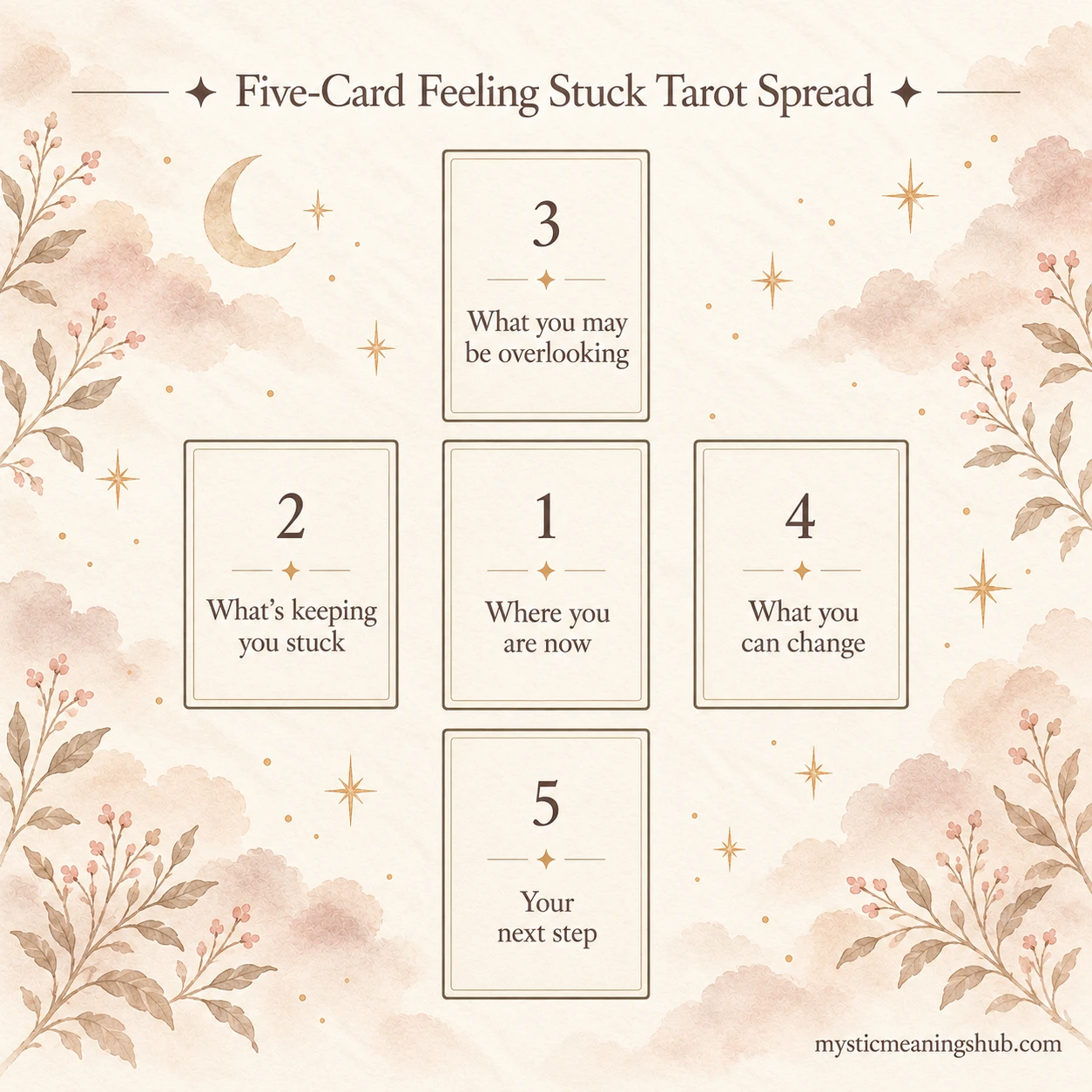
A five-card Feeling Stuck spread helps you look at a situation that isn’t going anywhere and consider what you could do next.
You can use it for a project you’ve stopped working on, a difficulty at work, or a routine you’d like to change. The five positions help you separate what’s happening, what’s getting in the way, and where you have some room to act.
When to Use This Spread
Try this spread when:
- You want to make progress but aren’t sure where to begin.
- You keep putting something off.
- You’ve tried the same approach several times without much changing.
- A project or plan has stalled, and you’d like to understand why.
How to Use the Spread
Choose one situation and ask “What could help me get unstuck here?”
Shuffle your deck, then draw five cards. Place card one in the centre, card two to its left, card three above it, card four to its right, and card five below it.
- Where you are now
- What’s keeping you stuck
- What you may be overlooking
- What you can change
- Your next step
You could also ask:
- What’s getting in the way of this project?
- What haven’t I considered about this situation?
- What could help me approach this differently?
What Each Position Means
1. Where You Are Now
The first card looks at what’s happening now and how you’re responding. It might reflect frustration, uncertainty, a lack of interest, or the effort you’ve already been making.
Relate it to something specific. What has been happening when you try to deal with this?
2. What’s Keeping You Stuck
This card looks at an obstacle or a condition that makes progress difficult. It could relate to your circumstances, another person’s involvement, a decision you’ve postponed, or an approach that isn’t working.
Consider how it connects with card one. For example, a card associated with heavy responsibilities could help explain why you’ve had little energy for something you want to do.
3. What You May Be Overlooking
The third card draws attention to something you haven’t fully considered. This might be help you could ask for, information you need, or an option you’ve dismissed.
Look at how it affects your understanding of the problem. Perhaps there’s another way to do the task, or someone with experience could answer a question you’ve been struggling with.
4. What You Can Change
This position focuses on an aspect of the situation you can influence. It might concern your expectations, how you’ve organised something, a commitment you’ve made, or the way you communicate.
This is the area to reconsider. The final card will help you turn that into a particular action.
5. Your Next Step
The fifth card suggests something you could try next. It might involve asking a question, testing an idea, changing a routine, or making a decision.
Read it with card four. If that card highlights how you use your time, for example, the next step could be to reschedule a task or set aside time for something you’ve been postponing.
Example Reading
Question: What could help me get back to writing a story I’ve left unfinished?
Card 1: Four of Cups — Where You Are Now
The Four of Cups may reflect feeling uninspired by the story. You might open the draft, read a little, and close it again because you can’t find anything you want to work on.
Card 2: Ten of Wands — What’s Keeping You Stuck
The Ten of Wands suggests too many demands on your time and energy. Perhaps you’ve been leaving writing until everything else is finished, by which point it feels like another task to complete.
Card 3: Three of Pentacles — What You May Be Overlooking
The Three of Pentacles points to cooperation and useful feedback. Showing a section to someone you trust could help you notice what already works or identify a part that needs attention.
Card 4: Two of Pentacles — What You Can Change
The Two of Pentacles suggests reviewing how the project fits alongside your other commitments. You might need to adjust when you write, how long you expect to spend on it, or what else you’re trying to fit into that time.
Card 5: Page of Wands — Your Next Step
The Page of Wands encourages curiosity and experimentation. You could choose a scene you’re curious about and spend twenty minutes trying it out, even if it’s later in the story than the section you’ve reached.
Reading the Cards Together
Together, these cards suggest that changing your writing routine and getting some feedback could help you return to the story. Leaving it until the end of a busy day gives you little chance to enjoy it, and working alone may have made it harder to see what to do next.
You might ask a trusted reader for feedback on one section, then choose a time when you can try an idea without rushing. Beginning with a scene that interests you gives that writing session a specific focus.
After Your Reading
Write down what you’d like to try and any information or help you’ll need. You can return to the spread after taking that step to see what you understand differently.