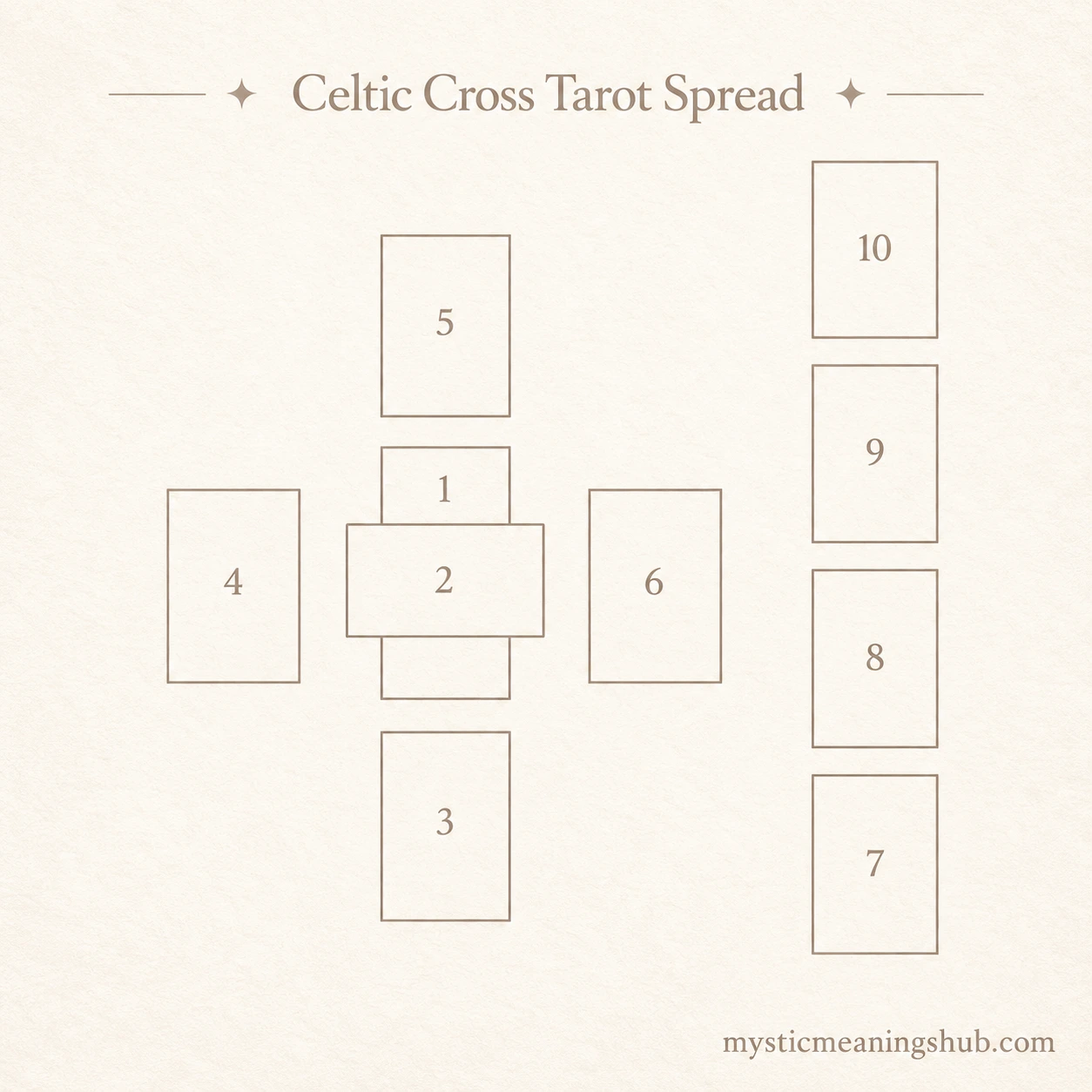
The Celtic Cross is a ten-card tarot spread for taking a closer look at a situation. It covers what’s happening now, what led up to it, the influences around you, and how things might develop.
It’s a good choice when several things are affecting the same question. You might be considering a change, trying to understand a relationship, or wondering why you keep running into the same difficulty.
When to Use This Spread
The Celtic Cross can be useful for:
- Decisions with several factors to consider.
- Changes in your work, relationships, or home life.
- Recurring problems you’d like to understand better.
- A fuller look at a situation that feels complicated.
Choosing Your Question
Choose one main question for the reading. Open questions work well, such as:
- What do I need to understand before changing jobs?
- What needs attention in this relationship?
- What could help me work through this disagreement?
- What do I need to consider before making this decision?
Being specific helps you relate the cards to what you’re asking.
How to Lay Out the Cards
Shuffle your deck with your question in mind, then draw ten cards. The first six form the cross, and the last four sit in a column to its right.
- The present situation: in the centre.
- The challenge: horizontally across the first card.
- The foundation: below the central pair.
- The recent past: to the left of the central pair.
- Your conscious thoughts: above the central pair.
- The near future: to the right of the central pair.
- Your approach: at the bottom of the column to the right of the cross.
- Outside influences: above card seven.
- Hopes and fears: above card eight.
- The potential outcome: above card nine.
You’ll find variations of this spread in different books and guides. The numbering here matches the meanings explained below.
What Each Position Means
1. The Present Situation
This card represents the main issue at the time of the reading. It may describe something happening in your life or how you’re experiencing it. Use it as a reference point when interpreting the other cards.
2. The Challenge
The second card shows what complicates the situation. It could suggest a disagreement, an obstacle, or a habit that’s getting in your way. Read it with card one to understand how the two interact.
3. The Foundation
This position looks at what underlies the situation. It may suggest a long-standing belief, an emotional need, or a pattern you haven’t given much thought to. Consider what might be contributing to the issue beneath the more obvious events.
4. The Recent Past
This card looks at what has recently happened and how it affects the present. An experience may be over, but still influence your expectations, feelings, or choices.
5. Your Conscious Thoughts
This position reflects what you’re thinking about and what you want to achieve. It can help you examine your expectations or the way you’ve been interpreting events. Compare it with card three to see how your thoughts relate to the underlying influences.
6. The Near Future
This card suggests what may happen next: an approaching development, a chance to act, or a difficulty to address. It describes a possible next stage in the situation.
7. Your Approach
This card focuses on how you’re responding. Are you taking action, waiting, protecting yourself, or seeking help? Consider how the card relates to your behaviour and whether that response is working for you.
8. Outside Influences
This position looks at the people and conditions affecting the situation. It might suggest support from someone, pressure from others, or practical limits such as time and resources.
9. Hopes and Fears
This card reflects what you want and what worries you. The two can overlap: you might hope for a fresh start while feeling nervous about what you’d have to leave behind.
10. The Potential Outcome
The final card suggests where the situation could lead if the current pattern continues. Read it alongside the earlier cards to understand what contributes to that possibility. Your choices, and changes in the circumstances, can affect how things develop.
How to Read the Cards Together
Start with cards one and two. They describe the main situation and its challenge.
For example, the Eight of Pentacles in position one might suggest you’re concentrating on learning or improving your work. The Five of Wands crossing it could point to disagreements or competing demands that make it hard to focus. Together, they might prompt you to consider how interruptions or friction with others are affecting your progress.
Then try these pairs:
- Cards three and five: how the underlying influences relate to your current thoughts and goals.
- Cards four and six: what’s passing and what may develop next.
- Cards seven and eight: how you’re responding to the people and circumstances around you.
Notice repeated suits or themes, too. Several Pentacles cards, for example, may draw attention to practical matters such as work, money, or everyday responsibilities.
Finish by looking at the outcome card in the context of the whole reading. Which earlier cards help explain it?
After Your Reading
Take a photo or write down the cards and your interpretation if you’d like to revisit the reading.
Try to finish with something specific: a factor you hadn’t considered, a pattern you’ve recognised, or a step you could take.
Related Tarot Cards
Cards that often appear in simple spreads and are easy to interpret include:
Related Spreads
Want to see how cards work together in a reading?
Explore the Tarot Combinations Guide